The Shadowing Technique: How to Do It, Whether It Works, and How to Choose a Shadowing App
Aelano Team · Updated
Short answer: Shadowing means speaking along with native audio as it plays, to practice pronunciation, intonation, and rhythm. To do it well, pick a short clip you can mostly follow, understand it before you speak, then shadow sentence by sentence. If you can’t keep up, slow down, use shorter sentences, or start with listen-pause-repeat. Move on once a sentence feels natural. A tool with word-level pronunciation feedback helps you see what you actually got wrong.
Lots of learners can understand far more than they can say. Shadowing is one of the simplest ways to close that gap on your own: you borrow a native speaker’s voice as a model and practice saying real sentences at real speed. This guide covers how to do it, what to do when it feels too fast, whether it actually works, and what to look for in a shadowing app.
What is the shadowing technique?
Shadowing is a speaking exercise where you listen to native audio and repeat it almost simultaneously, staying about half a beat behind, like a shadow. You copy the sounds, stress, intonation, and rhythm of the speaker.
It is not about memorizing the text. Here’s how it compares with two similar exercises:
| Exercise | How it works | What it trains |
|---|---|---|
| Shadowing | Speak along while the audio plays | Sounds, intonation, rhythm |
| Listen and repeat | Listen to a sentence, pause, then say it | Short-term memory, full pronunciation |
| Reading aloud | Read the text without audio | Decoding and smooth reading |
These work well together. When shadowing is too fast, step back to listen-and-repeat: play a sentence, pause, say it, then gradually shorten the pause until you are speaking along with the audio.
In Aelano, shadowing is step 4 of Practice (LS100): vocabulary review → blind listening → focused listening → shadowing. The first three steps help you understand the content; the last turns what you understood into something you can say. For in-app details, see Shadowing Practice.
How to do shadowing: the four-step method
Before you start: pick the right material
Material choice isn’t a step, but it decides how well the rest goes:
- Difficulty: you can follow the gist, but the speed feels slightly challenging. Too hard and you’ll never keep up; too easy and there’s nothing to practice.
- Length: start with 30 seconds to 2 minutes. Don’t try to shadow a whole episode.
- Content: real videos, podcasts, and shows tend to stick better than scripted textbook dialogues, because you remember the situation each phrase came from. Choose something you’d happily hear many times.
Step 1: Understand the clip first
Don’t speak yet. Listen once or twice, then read the transcript so you know what every sentence means and where the natural pauses fall.
If you shadow audio you don’t understand, you end up copying noises. You might get the sounds roughly right, but there’s no meaning attached, and very little stays with you.
Without an app: pick a video with subtitles, listen twice with subtitles off, then turn them on and go sentence by sentence. With Aelano: imported content gets a transcript and translation automatically; work through vocabulary review, blind listening, and focused listening first. These three steps don’t use any points.
Step 2: Shadow along with the audio
Play the audio and speak along about half a beat behind. Copy the whole shape of the speech: which words are stressed, where sounds link together, where the voice rises and falls, and where the speaker pauses.
With headphones, turning the original down a little helps you hear yourself. It’s fine to mumble at first. Get your mouth moving with the rhythm before worrying about every sound.
Step 3: Compare and get feedback
Shadowing without checking can lock in your mistakes. After each pass, compare yourself with the original:
- Without an app: record yourself on your phone and play it back next to the original. Listen for words that sound different and places where you stalled.
- With pronunciation feedback: see directly which words were mispronounced or missed, and how your fluency and pacing compare.
With Aelano: after each sentence, every word is marked correct, mispronounced, missed, or extra, along with pronunciation, fluency, and per-word scores. Replay the words you missed and try again. See Shadowing Practice.
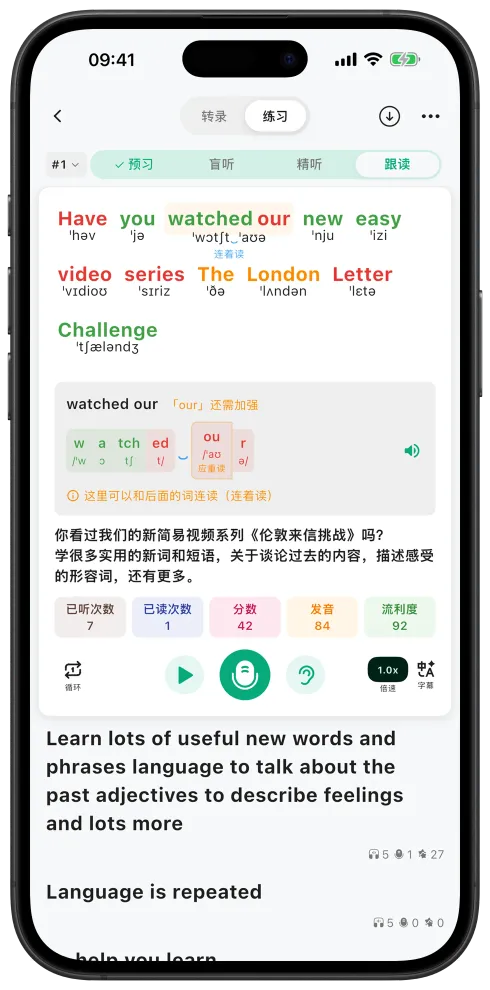
Step 4: Repeat the hard sentences
Don’t keep shadowing the whole clip from the top. Pull out the sentences where you stumbled and get one sentence smooth before moving to the next. Once the hard ones feel easy, shadow the full clip one more time.
Afterwards: review
Review isn’t a step, but it makes the session last. Save words and sentences you couldn’t pronounce or want to remember, then come back the next day: listen without subtitles and shadow again to see whether yesterday’s trouble spots still trip you up. In Aelano, save them to My Words & Sentences and revisit them with the Review System.
Can’t keep up? How many repetitions?
When the audio is too fast
Falling behind is the most common shadowing problem. Combine these:
- Slow it down: try around 0.75× speed, then return to normal once it feels smooth.
- Shorten the chunk: one sentence at a time, or even half a sentence.
- Listen, pause, repeat first: then shrink the pause until you’re speaking along.
- Shadow the rhythm first: hum or mumble the stress pattern, then fill in the full pronunciation.
If none of this helps and most sentences are still out of reach, the material is too hard. Pick something easier.
How many times to shadow a sentence
There is no fixed number. A common rule of thumb is three to ten repetitions per sentence, moving on once it feels natural and you stop stumbling. That’s experience, not science: some sentences click after two tries, others take a dozen.
Instead of counting, watch two things: are your hesitations and mistakes on a sentence going down, and does a new clip at the same level feel easier on the first try than it used to? Shadowing can make your pronunciation and rhythm more natural, but progress takes time and varies from person to person.
Is shadowing effective?
Shadowing is widely used by language learners, and it can be a useful way to practice pronunciation, rhythm, and speaking fluency, particularly when you have no one to talk to. It isn’t magic, though, and the learners who get the most out of it tend to agree on a few things. In discussions such as this r/EnglishLearning thread and this r/languagelearning thread, common points include:
- Understand first. Shadowing audio you don’t understand becomes mechanical repetition.
- Pick the right level. Material that’s far too hard leads to frustration, not progress.
- Check yourself. Without recording or feedback, it’s easy to repeat the same mistakes.
- Keep it short and regular. A few focused minutes on a short clip usually beats a long, unfocused session.
What shadowing mainly trains is the physical side of speaking: getting your mouth used to the sounds and rhythm of the language. It doesn’t replace building vocabulary or practicing real conversation, but it fits well alongside them.
Shadowing apps: how to choose one with pronunciation feedback
You can shadow without any app. But if you want to know whether you’re saying things right, pronunciation feedback saves a lot of back-and-forth comparing. Before choosing, think about:
- Can you use your own content? Only built-in lessons, or can you import YouTube videos, podcasts, or local files?
- Is there pronunciation and fluency feedback? And how detailed is it: one score per sentence, or word by word?
- Does it support the language you’re learning? Support beyond English varies a lot.
- Does it work on your phone? This matters if you practice on the go.
- Does scoring cost extra? Check whether it needs a subscription or uses credits, according to each product’s own pricing page.
Common types of shadowing tools
Tools that help with shadowing fall roughly into a few types. Each suits different learners.
| Type | Content | Shadowing feedback | Good for |
|---|---|---|---|
| Dedicated pronunciation / shadowing apps | Mostly built-in sentences or courses | Usually pronunciation scoring; detail varies | Following a structured pronunciation course |
| Single-language listening apps | A built-in library for one language | Some include shadowing scores | Learning one language with ready-made material |
| Browser subtitle extensions | Web videos on a computer | Some include a practice mode | Learning mainly from videos on desktop |
| Subtitle and transcript tools | Imported videos and podcasts | Focus on listening and looping; feedback varies | Understanding content and intensive listening |
| Aelano | Imported YouTube and Bilibili videos, podcasts, or local files | Each word marked correct / mispronounced / missed / extra, plus pronunciation and fluency scores | Shadowing real content you choose, with word-level feedback |
There is no single best tool. If you just want a structured course, a dedicated pronunciation app is enough. If you’re learning one language and don’t want to hunt for material, a single-language app is convenient. If you want to shadow your own videos and podcasts and see exactly which words you got wrong, Aelano is a good match. Shadowing scores use points, and no membership is required.
Shadowing in other languages
The method works for any language. A few language-specific notes:
- Japanese: syllables have a fairly even rhythm, which makes Japanese well suited to shadowing for intonation and speed. Everyday dramas, variety shows, vlogs, and podcasts are better models than anime, where exaggerated character voices are common.
- Korean: final consonants often carry over into the next syllable, so spelling and actual pronunciation differ. Listen closely to how the speaker links sounds, and pay attention to sentence endings, which change with politeness level.
- Spanish: everyday speech is often fast, so use shorter chunks and slow down when needed. Pick one accent (Spain or Latin America) and stick with it.
- French and German: in French, practice linking (liaison) and dropped sounds; in German, watch word stress and break long compound words apart before putting them back into the sentence.
- Tonal languages such as Thai, Vietnamese, and Cantonese: get the tones right first. Slow down and copy the pitch of each syllable, then return to normal speed.
For any language, choose everyday content you can mostly follow and start with short clips. Aelano supports transcription for more than 100 languages, so you can import videos or podcasts in Japanese, Korean, Spanish, French, German, Thai, and many others. See supported languages. Shadowing scores are relatively accurate for major languages (English, Japanese, Korean, Chinese, German, French, Spanish, and so on) and may be less accurate for less common ones; you can loosen the scoring strictness in settings.
How to practice speaking alone
Not having a conversation partner is one of the biggest obstacles to speaking practice. Shadowing works on your own: the original audio is your model, and a recording or AI feedback is your check, so you don’t need to wait for anyone.
It mainly trains pronunciation, rhythm, and saying complete sentences smoothly. Once a sentence feels easy, try saying it without the audio, or swap a few words to talk about your own life. That’s how you move from imitating to expressing.
Shadowing with Aelano
To put the method into practice on your phone:
Import content
Copy a YouTube video, Bilibili video, or Apple Podcasts link and paste it into Aelano’s Import from Link. You can also upload local audio or video files you have the rights to use. See Import Videos and Podcasts for supported platforms.
Get a transcript and translation
Aelano transcribes the content automatically and adds a sentence-by-sentence AI translation. Show both, or only the original.
Work through Practice
Switch to Practice and go through vocabulary review, blind listening, focused listening, and shadowing for each segment, or jump straight to shadowing the sentence you want to work on.
Check the feedback and try again
Look at the word colors and the pronunciation and fluency scores, replay the words you missed, and shadow again. Move on once it feels smooth.
Save and review
Save words and sentences you want to remember to My Words & Sentences and review them later with spaced repetition.
On cost: the first three steps (vocabulary review, blind listening, focused listening) don’t use points. Shadowing scores use points because they need AI pronunciation assessment. No membership is required; free users can use their available points, and membership gives a larger monthly allowance. See pricing. You’ll need to allow microphone access the first time you shadow.
Aelano can’t import paid, region-locked, or copyright-protected platform content.
FAQ
What is the shadowing technique?
Shadowing is a speaking exercise where you listen to native audio and repeat it almost at the same time, like a shadow. The goal is to imitate pronunciation, intonation, and rhythm, not to memorize the text.
Is shadowing effective?
It can be a useful way to work on pronunciation, rhythm, and speaking fluency, especially when you have no one to practice with. Most learners who report good results stress the same condition: understand the material first, and don't just parrot sounds you can't make sense of.
What if I can't keep up with the audio?
That's normal at the start. Slow the audio down, use shorter clips, or start with listen-pause-repeat and gradually shorten the pause until you can speak along. You can also shadow only the rhythm and stress first, then fill in the full pronunciation.
How many times should I shadow a sentence?
There is no fixed number. Three to ten times per sentence is a common rule of thumb, but the real signal is when you can say it naturally without stumbling. Watch whether your hesitations and mistakes go down rather than counting repetitions.
Should I understand the audio before shadowing?
Yes. If you shadow audio you don't understand, you end up copying sounds without the meaning behind them, and very little sticks. Listen once or twice and read the transcript first.
Is there an app for shadowing with pronunciation feedback?
Yes. Options range from dedicated pronunciation apps with built-in lessons to subtitle and transcript tools that work with your own videos. Aelano lets you shadow imported YouTube videos, podcasts, and local files, and marks each word as correct, mispronounced, missed, or extra, with pronunciation and fluency scores.
Can I use shadowing for languages other than English?
Yes. The method works for any language. Japanese and Korean learners use it a lot, and for tonal languages such as Thai, Vietnamese, or Cantonese it helps to shadow the tones slowly before going back to full speed. Aelano supports transcription for more than 100 languages.
How does Aelano score shadowing, and is it free?
After each sentence, every word is marked correct, mispronounced, missed, or extra, and you get pronunciation, fluency, and per-word scores. You don't need a membership to use it, but each shadowing score uses points. The first time, you'll need to allow microphone access.